- Accept card payments – lowest rates from 0.27%
- Keep your card processing fees to a minimum
- Direct access to the UK’s leading card processing banks
- We ensure your rates always remain competitive
No spam emails or calls
Choose from the payment methods then click Next
What's your turnover each month?
Enter the name of your company
Enter your company's postcode and contact number
Tell us what you need
Fill in our quick form and we’ll give you a call for a brief 5-minute chat to understand exactly what you're looking for.
Get tailored quotes
We’ll match you with up to three of the most competitive offers from our trusted providers that suit your business.
Pick with confidence
We’ll help you understand the options so you can choose the best fit — quickly, clearly, and without any pressure.




Taking Payments Online
Start here: how to begin taking payments online today
If you run a UK business and want to accept payments online without overpaying, you are in the right place. Too many merchants sign up for the first solution they find, only to discover hidden fees and rigid contracts months later. We are here to help you avoid that.
To start taking payments online, you typically need three core components: a merchant account (where funds settle before reaching your bank), a payment gateway (the technology that securely transmits card details), or an all-in-one payment solution that bundles everything together. These components enable you to accept card payments online by securely processing transactions and transferring funds to your business. To accept online card payments, you need to work with each of these players, either via a single payment service provider or by building your own integrations. The route you choose depends on your business model, transaction volumes, and technical setup. Whether you use a payment gateway, merchant account, or an all-in-one solution, each option allows you to collect payments efficiently from your customers, including one-off and recurring payments.
As a merchant services broker UK wide, we compare card processing fees and online payment options across multiple acquirers and payment gateway providers UK based and international. Our service costs you nothing. We use our volume leverage with banks and processors to secure better rates than you are likely to get going direct, and we pass those savings straight to you.
Ready to see what you could save? Upload a recent merchant statement or online gateway report, and we will prepare a free, no-obligation cost analysis within 48 hours.
- Get a clear picture of what you currently pay versus what you could pay
- Receive a shortlist of suitable providers matched to your business
- Understand the true cost of different payment methods before you commit
- Access wholesale-level pricing through our bulk buying power
To get started, create a free account with one of our recommended payment platforms and start collecting payments online today.
How online payments work in practice
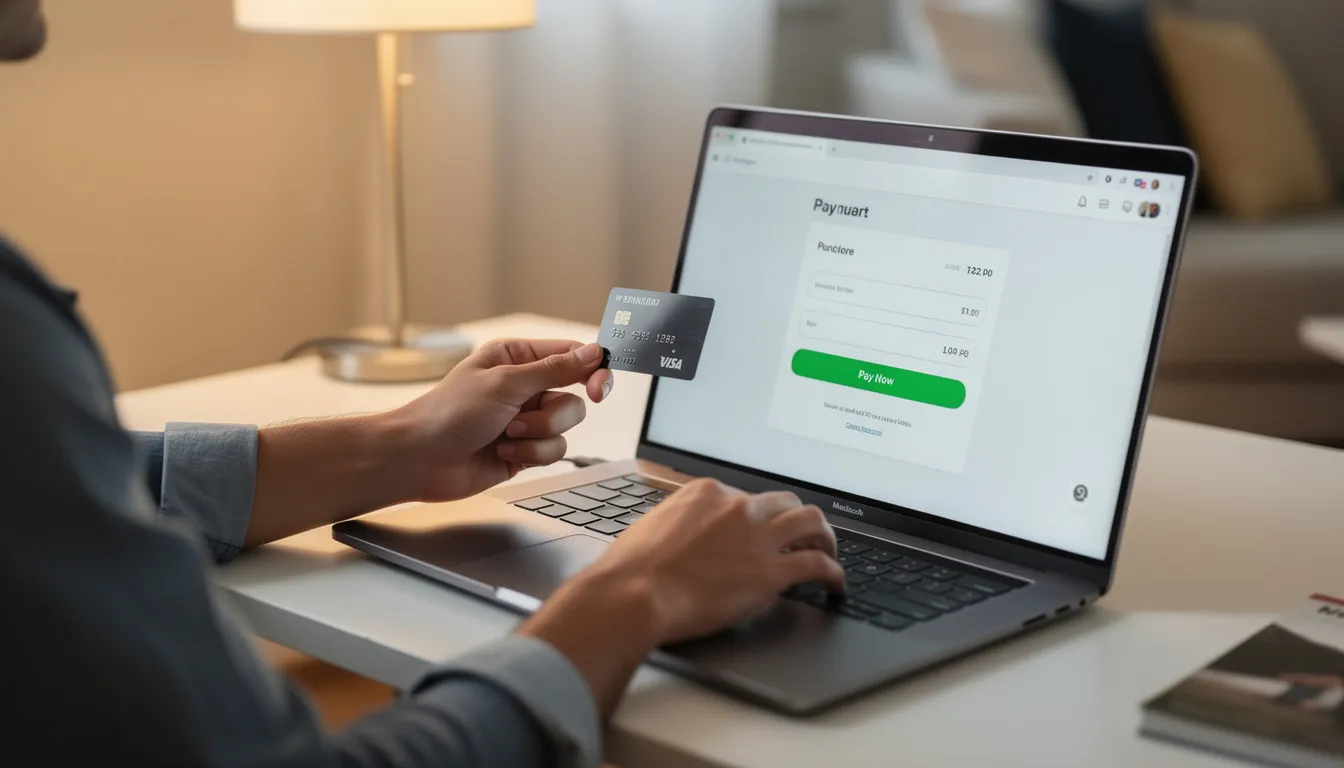
Understanding how online payments actually flow from customer to your business bank account helps you make smarter decisions about which providers to use and where costs creep in. The process happens in seconds, but several parties play a role in processing payments, including the cardholder, merchant, acquirer, and issuing bank.
When a customer enters their card details on your website, that information travels through your payment gateway, which encrypts and tokenises the sensitive data. The gateway sends an authorisation request to the payment processor, which routes it to the acquiring bank (the bank that holds your merchant account). The acquirer then communicates with the card networks (Visa, Mastercard, Amex) and the customers bank accounts or card issuer. If the issuing bank approves the transaction, the chain reverses, and your checkout confirms the sale. Settlement typically follows within one to three business days, depending on your arrangement.
A merchant account is not the same as a standard business account. Banks underwrite merchant accounts separately because they take on risk: if a customer disputes a charge or you fail to deliver, the acquirer may have to cover the loss. This is why underwriters look at your trading history, chargeback exposure, and sector risk before approving you.
Payment gateways keep your business outside the highest PCI DSS scope by handling card data on their secure servers. You never see the full card number, which reduces your compliance burden and protects customer data from breaches on your systems. PCI Data Security Standards (PCI DSS) apply to all entities involved in storing, processing, or transmitting cardholder data.
Beyond card payments, alternative flows exist for Direct Debit (where you pull funds from customers bank accounts on agreed dates), instant bank payments using Open Banking, and digital wallets such as Apple Pay, Google Pay, and PayPal. For Direct Debit and bank payments, you will need to collect customers banking information, such as account numbers and sort codes, to facilitate these transactions. Each method has different cost structures, settlement times, and customer experience implications.
We design this payments flow with you so it fits your website, CRM, and accounting system rather than forcing you into a one-size-fits-all solution. Whether you use Shopify, WooCommerce, a custom build, or no website at all, we find the right combination of merchant account, gateway, and payment methods to match your operations.
The payment journey in simple steps:
- Customer selects products or services and proceeds to checkout on your site or payment link
- Customer chooses their payment method and enters payment details (card number, wallet credentials, or bank details)
- Your payment gateway encrypts and tokenises the data, then sends an authorisation request
- The payment processor routes the request through the card networks to the card issuer or bank
- The issuing bank checks available funds, fraud signals, and authentication (such as 3D Secure)
- The issuing bank extends credit and issues cards to consumers on behalf of the card networks.
- Approval or decline travels back through the chain, and your checkout displays the result
- Funds settle into your merchant account, then transfer to your business bank account on your agreed schedule
Choosing the right way to take payments online
Broadly, UK businesses have two routes to accept payments online. You can set up a separate merchant account with an acquiring bank and connect it to an independent payment gateway of your choice. Alternatively, you can use an all-in-one payment service provider that bundles merchant account, gateway, fraud tools, and reporting into a single package.
When selecting your payment setup, consider supporting popular payment methods such as credit/debit cards, digital wallets (like Apple Pay and Google Pay), and bank transfers to meet customer expectations and maximize conversion.
Neither route is universally better. The right choice depends on your circumstances.
Typical use cases:
- A small UK start-up using a simple ecommerce platform may prefer an all-in-one PSP for speed and simplicity
- A growing subscription or SaaS business often benefits from a dedicated merchant account with a gateway that supports recurring billing and dunning management
- An established retailer adding click-and-collect might integrate a new gateway with their existing card payment solution
- A B2B services firm taking online invoice payments may need payment links, Direct Debit, and bank transfer options rather than a traditional checkout
Key decision factors:
- Monthly transaction volume and projected growth
- Average ticket size (high value transactions attract different fee structures)
- Risk profile and chargeback exposure in your sector
- International sales and multi-currency requirements
If you plan to sell internationally, supporting local payment methods—such as iDEAL in the Netherlands or other regional options—is crucial to accommodate customers in different regions and improve conversion rates.
- Technical resources in-house or via your web agency
- Contract flexibility and exit terms
The best online payment methods for small businesses include credit or debit cards, digital wallets, and bank transfers, with an emphasis on customer preferences.
The “cheapest” option on headline rate often hides higher cross-border, card-not-present, or chargeback costs. We model real scenarios using your actual transaction data before you sign anything, so you see the true effective rate rather than a marketing number.
We compare card processing fees across multiple UK acquirers and payment gateway providers UK regulated, then present a plain English summary showing you the genuine cost differences. No jargon, no surprises.
Send us your basic details (monthly turnover, average transaction value, key markets) and we will recommend a route within 24 to 48 hours, completely free of charge.
Core online payment methods your customers expect
Modern UK customers expect to pay in their preferred way. Whether that means card, bank transfer, wallet, or buy now pay later, offering the right mix at checkout directly affects your conversion rates and revenue. Debit card payments online are a key option, allowing you to meet customer expectations for convenience and security.
We help clients select payment methods based on their sector and customer behaviour. For example, Direct Debit suits gyms and membership bodies collecting monthly fees. Cards and digital wallets work well for ecommerce. Bank transfers make sense for high value B2B invoices where card fees would be prohibitive.
Offering multiple payment methods increases conversion but can add complexity and cost. Each method brings its own fee structure, risk rules, and contractual terms. That is why we rationalise providers and negotiate fee structures on your behalf, so you get the benefits of flexibility without the administrative headache.
Let us review your checkout page or payment flow. We will suggest concrete improvements to payment options and layout that could lift your conversion rate.
Main payment method categories:
- Card payments (Visa, Mastercard, Amex): The backbone of UK online retail, hospitality, and service businesses. Immediate confirmation, global acceptance, strong fraud protection, and the ability to accept debit as well as credit cards. Card payments are now the most popular way to pay in the UK, representing more than half of all transactions.
- Direct Debit: Ideal for recurring payments like subscriptions, memberships, and retainers. Lower fees than cards for many businesses, with predictable collection dates
- Bank transfers and Open Banking: Suited to high value B2B invoices, deposits, and one-off payments where card fees would be excessive
- Digital wallets (Apple Pay, Google Pay, PayPal): Fast, secure checkout using saved credentials. Popular with mobile shoppers and younger demographics
- Buy Now Pay Later (Klarna, Clearpay): Increases average order value for fashion, electronics, and lifestyle ecommerce by letting customers spread payments
Accepting cards builds trust with your customers, helps you capture every sale, and improves their buying experience.
The choice of online payment method can impact cash flow and administrative workload for businesses.
Card payments online
Credit card payments and debit card payments remain the backbone of online payments for UK retail, hospitality, and many service businesses. Visa and Mastercard dominate, with Amex relevant for certain customer segments.
When a customer enters their card details on your website, those details travel through your payment gateway to the payment processor and onward to the card issuer. If you use a secure vault managed by your PSP or gateway, returning customers can pay with saved cards, reducing friction and boosting conversion.
3D Secure 2 and Strong Customer Authentication (SCA) are now mandatory for most UK and EU card transactions. These authentication steps add a layer of security (such as a one-time passcode or biometric check) that reduces fraud but can affect conversion if not implemented smoothly. We help clients configure SCA flows to balance security with a seamless checkout experience.
Card costs break down into three main components. Interchange fees go to the card issuer. Scheme fees go to Visa or Mastercard. The acquirer markup is what your bank or PSP charges on top. We negotiate the acquirer markup using our bulk buying power, often securing rates below what you would be quoted directly.
Consider a UK fashion retailer processing £100,000 per month in online card payments. A reduction of just 0.2% on their effective rate saves £2,400 per year, and that saving compounds as the business grows. We regularly achieve reductions of this scale and higher for our clients.
We compare card processing fees, challenge “standard” rates, and design card setups that balance cost and approval rates. If you accept credit and debit cards online, we can almost certainly improve what you pay.
Direct Debit and account-to-account payments
Direct Debit is ideal for recurring payments: subscriptions, memberships, school fees, professional services retainers, and utilities. If your customers pay you on a regular schedule, direct debit payments provide an automated way to collect payments efficiently and reliably. Direct Debit deserves serious consideration.
The Bacs scheme underpins Direct Debit in the UK. You collect a mandate from the customer (often online via a simple form), and then you pull payments from their bank account on specific dates. Unlike cards, Direct Debit mandates do not expire when a customer gets a new card, which reduces involuntary churn for subscription businesses.
Chargeback rules differ from cards. Customers can request refunds under the Direct Debit Guarantee, but dispute rates tend to be lower for legitimate businesses with clear communication. Processing costs are typically lower than card fees, especially for high volume or high value collections.
For one-off high value payments, deposits, and large B2B invoices, instant account-to-account payments using Open Banking offer another option. The customer authorises a payment directly from their bank app, and funds arrive quickly without card scheme involvement. This suits businesses where card interchange would eat into margins.
We work with specialist bank payment providers to secure access to these options. GoCardless is a secure, online account-to-account payments specialist enabling you to accept online bank payments via their API or online merchant dashboard. We advise clients when Direct Debit or instant bank payments will genuinely save money versus other methods.
Use cases for Direct Debit and bank payments:
- Gyms and fitness studios collecting monthly memberships
- Software-as-a-service businesses billing annual or monthly subscriptions
- Accountants and solicitors collecting retainers
- Schools and clubs collecting termly or annual fees
- B2B suppliers receiving large invoice payments
GoCardless merchants get paid faster, spend less time on financial admin and enjoy improved cash flow with Direct Debit. GoCardless offers a cost-effective, easy-to-use, automated bank payment collection service that reduces costs and manual admin.
If you have recurring revenue or large invoice values, ask us for a Direct Debit or bank payment feasibility review. Automating payment collection can reduce administrative burdens and improve cash flow for businesses.
Digital wallets, BNPL, and alternative methods
UK and European customers increasingly use wallets such as Apple Pay, Google Pay, and PayPal for speed and perceived security. Digital wallet transactions have grown 62% year-over-year, making this the fastest-growing payment category.
For ecommerce businesses in sectors like fashion and consumer electronics, buy now pay later options like Klarna or Clearpay can increase conversion and average order value. Customers appreciate the flexibility to spread payments, and you receive the full amount upfront (minus the provider’s fee).
Each additional payment method adds its own fee structure, risk rules, and contractual terms. We review these so you do not overpay for features you do not need or sign contracts with unfavourable terms.
We also help ensure wallet and BNPL options are surfaced sensibly in checkout design. The goal is to boost conversion without confusing customers or cluttering the payment page.
Key considerations for alternative methods:
- Apple Pay and Google Pay require compatible gateway integration and may have different fee structures from standard card payments
- PayPal charges its own transaction fees on top of any merchant account costs
- BNPL providers take a percentage of the sale, which can be higher than card interchange for lower-ticket items
- Not every method suits every customer base; we help you identify which options genuinely add value
Share your current payment method mix with us. We will advise which methods are earning their place and which are costing you more than they return.
Setting up to take payments through your online shop
This section provides a concrete checklist for UK ecommerce businesses, not vague theory. Whether you are launching a new online shop or upgrading an existing setup, follow these steps.
Some ecommerce platforms (Shopify, WooCommerce, Wix, BigCommerce) have pre-built integrations with many payment gateway providers UK based and global. Modern payment solutions also let you accept contactless cards and offer tap to pay options, providing convenience and security for in-person and online transactions. We help you choose between them based on your specific needs: fee structures, fraud tools, international card support, and settlement options.
We handle bank applications, risk questions, and technical coordination with your developers or agency so you do not lose weeks to form filling. Our goal is to get you live quickly with a setup that works for your business long term.
Send us the platform you use, your average monthly card volume, and your main markets. We will propose a shortlist of suitable providers within 48 hours.
Steps to set up online payments for your shop:
- Define your requirements: payment methods needed, expected volumes, international reach, and integration with your ecommerce platform
- Choose between a dedicated merchant account plus gateway or an all-in-one PSP
- Note: Wix Payments allows you to accept debit/credit cards, Apple Pay, Tap to Pay on iPhone and Android, Google Pay, and other popular payment methods.
- Gather required documents: trading history, bank statements, incorporation details
- Submit applications (we handle this on your behalf and manage queries)
- Configure your payment gateway or PSP integration with your checkout. Payment gateways such as Stripe, PayPal, and Square simplify the setup process for e-commerce by integrating card processing and digital wallets.
- Test transactions across scenarios: UK cards, EU cards, refunds, failed payments. Before launching an online payment system, it is advisable to run test transactions using the provider’s sandbox mode.
- Go live and monitor approval rates, declines, and chargebacks in the first 90 days
- Review and renegotiate as your volume grows or risk profile improves

Choosing and opening a merchant account
Underwriters in the UK assess several factors when approving a merchant account in 2024. They look at your trading history, chargeback risk, sector risk, and director credit profiles. New businesses without processing history may face additional scrutiny or require personal guarantees.
Documents typically required:
- Recent business bank statements (usually three to six months)
- Management accounts or filed accounts
- Certificate of incorporation and memorandum of association
- Photo ID and proof of address for directors
- Existing processing statements if you are switching providers
Key commercial terms to review:
- Contract length and early termination conditions
- Minimum monthly service charges
- Settlement times (next day, T+2, weekly)
- Chargeback fees and thresholds
- PCI compliance fees and gateway charges
We negotiate these terms on your behalf. We often reduce headline rates, waive setup fees, shorten contract tie-ins, or remove them entirely. For example, we recently helped a UK SME move from a 48-month contract with their existing provider to a rolling monthly arrangement with a new acquirer, saving them over 15% on effective rates without losing service quality.
Stuck in an expensive legacy contract? Send us your agreement and we will check for break clauses or re-pricing options.
Selecting and configuring a payment gateway
Payment gateways come in three main types:
- Hosted payment pages: The customer is redirected to a secure page hosted by the gateway provider. Simple to implement, lower PCI burden, but less control over checkout design
- Embedded forms: Payment fields appear within your checkout page but are served by the gateway. Good balance of branding control and security
- Full API integrations: Maximum flexibility and customisation, but requires developer resources and higher PCI scope
Key evaluation criteria:
- UK and international card support
- Fraud tools (AVS, CVV checking, velocity limits, machine learning scoring)
- Recurring billing features for subscription payments
- Reporting quality and data export options
- Settlement options and currency handling
We maintain active relationships with multiple UK and global gateway providers. We help you integrate your chosen gateway with your ecommerce platform, CRM, and accounting tools so reconciliation and reporting are as automated as possible.
Share a screenshot or description of your current checkout. We will flag gateway improvements quickly and without obligation.
Testing, going live, and monitoring performance
Before going live, run test transactions across different scenarios: UK card, EU card, failed payment, refund, and subscription billing. This catches configuration issues before real customers encounter them.
In the first 30 to 90 days after launch, we track approval rates, fraud declines, and chargebacks to ensure your new setup performs correctly. A sudden spike in declines or disputes often indicates a configuration problem or fraud attack that needs immediate attention.
We help you interpret gateway and acquirer reports so you understand your true effective rates, not just headline fees. Many businesses discover they are paying more than expected once cross-border fees, premium card surcharges, and minimum charges are factored in.
Our team remains available after go live. If your volume grows or your risk profile improves, we renegotiate fees to reflect your stronger position.
Already live but unsure what you are really paying? Send us your last three months of statements for a free review.
Post-launch monitoring checklist:
- Review approval rates weekly for the first month
- Check for unusual decline codes or fraud flags
- Reconcile settlements against gateway reports
- Monitor chargeback notifications and respond within deadlines
- Schedule a 90-day review to assess performance and renegotiation opportunities
Taking payments online for services, invoices, and subscriptions
Not every UK business has a classic ecommerce shop. Many invoice clients, sell retainers, or run subscription or membership models. The good news is that online payment options exist for every billing model, making it easier to collect payments efficiently and securely from your clients.
The main options include online invoicing with card or wallet payment links, Direct Debit for recurring fees, and account-to-account bank payments for larger B2B invoices. Bank transfers are a straightforward online payment method that involves customers manually sending funds from their bank accounts. The right combination depends on how you bill and what your customers prefer.
Examples:
- Accountants collecting monthly retainers can use Direct Debit for predictable cash flow
- Marketing agencies with fixed monthly fees plus project work might combine Direct Debit for retainers with payment links for one-off project invoices
- Tradespeople who invoice after site visits can send payment links by email or SMS, letting customers pay by card or wallet instantly
We match billing models to payment methods. For long-term recurring fees, Direct Debit usually makes sense. For deposits and one-off work, card or instant bank payments often work better.
Share how you bill today (even if it is just PDFs with bank details) and we will map out a modern online payment process that reduces late payment and admin overhead.
Payment links, online invoices, and pay-by-email
Payment links let you send a secure URL by email, SMS, or WhatsApp. The customer clicks through to a hosted payment page, enters their card details or selects a wallet, and pays instantly. No website required.
This approach suits freelancers, trades, consultants, and any business that invoices clients rather than selling through a checkout. Many UK payment gateway providers and PSPs offer branded invoice and link tools that settle to the same merchant account as your website transactions.
We compare card processing fees and payment link charges so you do not overpay for convenience features. Some providers bundle link functionality for free; others charge per link or add hidden fees.
Advantages of payment links:
- Get paid faster by removing the friction of bank transfers and manual payment
- Reduce chasing by sending automatic reminders
- Accept credit card payments and wallet payments without building a full checkout
- Track payment status in real time
- Reconcile easily with accounting software integrations
Still relying on bank transfer and manual chasing? Let us design a low-friction payment link solution that gets you paid faster.
Subscriptions, memberships, and recurring billing
UK subscription businesses face common challenges: involuntary churn from expired cards, failed payments, and admin overhead managing renewals and cancellations.
Card-based recurring billing offers convenience for customers and predictable revenue for you, but cards expire and get lost. When a stored card fails, you lose revenue unless you have systems to recover it. Direct Debit avoids this problem because mandates stay valid regardless of card changes.
We often recommend combining both methods for resilience. Customers choose their preferred option at signup, and you benefit from lower failure rates overall.
We work with recurring billing platforms and gateways that handle proration, upgrades, downgrades, and dunning communications (the automated emails and retries that recover failed payments). Proper dunning can recover 20% or more of otherwise-lost revenue.
Example: A subscription box service we work with reduced failed payments by 35% after moving to a mixed card and Direct Debit solution. Customers who previously churned involuntarily now stay subscribed, and the business spends less time chasing payment problems.
If you have more than 50 recurring customers, ask us for a recurring payments audit and proposal.
High-risk sectors and hard-to-place merchant accounts
In 2024, acquirers classify certain sectors as “high risk” due to elevated chargeback rates, regulatory scrutiny, or reputational concerns. These include travel and ticketing, online gaming, nutraceuticals and supplements, CBD, adult services, firearms, and some financial services.
Mainstream banks often decline these sectors outright or quote prohibitive rates. This leaves many legitimate UK businesses struggling to accept payments online at all, or stuck with providers who charge excessive fees and impose onerous terms.
We maintain relationships with acquirers and payment gateway providers UK and offshore that actively support compliant high-risk models. We know which banks accept your industry, what documentation strengthens your application, and how to position your business to underwriters.
Rolling reserves, volume caps, and enhanced due diligence are common in high-risk processing. We negotiate these terms to keep your cash flow as healthy as possible. A reserve that starts at 10% held for 180 days might be reduced to 5% held for 90 days once you establish a track record.
We never promise high risk merchant account instant approval, because that promise is unrealistic. What we do offer is significantly increased chances of fast, positive decisions by packaging applications correctly and submitting to the right acquirers.
If you have been declined or are paying too much because of your sector, contact us for a confidential review. Share your processing history and any acquirer rejections, and we will advise on realistic options.
Compliance, underwriting, and rolling reserves
Acquirers underwrite risk by assessing expected chargeback levels, refund rates, and your compliance with regulatory obligations like AML (anti-money laundering) and KYC (know your customer). They want to see that you operate transparently, handle disputes fairly, and will not expose them to unexpected losses.
A rolling reserve is a portion of your processing volume (often 5% to 15%) held by the acquirer for a set period (typically 90 to 180 days) as security against chargebacks or refunds. This affects your cash flow because you do not receive the reserved funds until the holding period expires.
We regularly negotiate lower reserves, shorter reserve periods, or alternative security arrangements where business performance supports it. If you have processed for six months with low chargebacks, we can often approach your acquirer for a reserve reduction.
We also help high-risk merchants prepare supporting documents, policies, and disclosures that reassure underwriters. Clear refund policies, robust fraud prevention measures, and transparent marketing all improve your application.
Currently under a heavy reserve? Contact us to review whether alternative acquirers or renegotiation could improve your position.
Controlling costs: comparing and reducing online card processing fees
Many UK businesses overpay for online payments because fee structures are complex and hard to compare. Headline rates tell only part of the story.
Typical cost components include per-transaction fees, percentage fees (which vary by card type and region), monthly minimum charges, chargeback fees, PCI compliance fees, and cross-border or currency surcharges. Two providers quoting the same headline rate can have vastly different true costs once you factor in these variables.
We analyse real merchant statements, not just rate sheets, to calculate effective blended rates by card type, region, and channel. This shows you what you actually pay today and what you would pay with alternative providers.
The volume leverage argument is simple: we bring banks and PSPs significant aggregate processing volume from our client base. In return, they offer us wholesale-level pricing that individual merchants rarely access. We pass those savings to you.
Our service is free to your business. The acquiring bank or PSP pays us a separate commission, so our interests align with achieving genuine long-term savings for you. If we do not save you money, we do not get paid.
Send us at least one recent merchant statement or gateway invoice. We will produce a simple side-by-side comparison with alternative offers, showing you exactly what you could save.
What we look at when we compare card processing fees
We review specific items that affect your true cost:
- Effective percentage rate by card scheme (Visa, Mastercard, Amex)
- Non-qualified or premium card surcharges (corporate cards, international cards)
- Cross-border fees for transactions from outside the UK
- High-risk category markups if applicable
- Settlement times and how they affect your cash flow
- Chargeback handling costs per dispute
- Minimum monthly service charges that erode savings on low-volume months
- Authorisation fees and transaction fees that add up on high-volume businesses
- Hidden fees buried in terms and conditions
We model realistic scenarios over 12 months using your own transaction history rather than idealised assumptions. This accounts for seasonality, average ticket size, card mix, and customer geography.
We present findings in plain English. For example: “This option is likely to save you around 18% on like-for-like volume while improving settlement from T+3 to next day.”
Financial controllers and finance directors: Book a call with our team to walk through a sample analysis using anonymised data from businesses similar to yours.
Keeping online payments secure and compliant
Security and compliance matter for three reasons: fraud risk, data protection obligations under UK GDPR, and reputational damage from breaches. Customers trust you with their payment information, and that trust must be protected.
Key standards in simple terms:
- PCI DSS: The Payment Card Industry Data Security Standard applies to any business that handles card data. Using a PCI-compliant payment gateway or PSP that tokenises and vaults card data keeps you outside the highest compliance scope
- SCA and 3D Secure 2: Strong Customer Authentication under PSD2 requires two-factor verification for most online card payments in the UK and EU. Proper implementation reduces fraud without killing conversion
- Fraud monitoring: Acquirers expect you to monitor for suspicious activity and respond to chargebacks within deadlines
We do not store card data ourselves. We help you choose PCI-compliant payment gateway providers and PSPs that tokenise and vault data securely, so sensitive data never touches your servers.
Practical controls you can implement:
- Strong passwords and two-factor authentication on gateway portals
- Role-based access so only authorised staff can process refunds or view reports
- Regular reconciliation to catch discrepancies early
- Prompt response to chargeback notifications
- Clear refund and cancellation policies that reduce disputes
A secure payment setup also tends to be more reliable and trusted by card schemes and banks, which can improve approval rates over time.
Unsure about your current PCI status or SCA setup? Ask us for a quick compliance review alongside your fee review.
Working with the right payment partners
We prioritise providers with strong UK regulatory credentials, transparent dispute processes, and proven anti-fraud capabilities. Not all gateways and PSPs are equal in these areas.
We assess gateway and PSP fraud tools including velocity checks, AVS (Address Verification Service), CVV checking, and behavioural scoring. We help tune these settings so they block genuine fraud without declining legitimate customers. Overly aggressive fraud rules can cost you more in lost sales than they save in prevented fraud.
We stay informed about scheme and regulatory changes, then proactively advise clients when configuration updates are needed. When 3D Secure 2 became mandatory, we helped clients update their integrations before the deadline rather than scrambling afterwards.
Let us review your current fraud settings and decline reasons. If you see unusual spikes in failed payments, there may be configuration issues we can fix quickly.
How we work with you and what to do next
We are a merchant services broker UK businesses rely on to source, negotiate, and maintain online payment solutions tailored to their goals. We sit on your side of the table, not the bank’s.
Our typical process:
- Discovery call: We learn about your business, current setup, pain points, and goals
- Data collection: You share recent statements and current contracts (all kept strictly confidential)
- Market search: We approach our network of acquirers and payment gateway providers with your requirements
- Proposal presentation: We present options in plain English, showing true costs and trade-offs
- Onboarding support: We manage applications, answer underwriter queries, and coordinate with your developers or agency
- Ongoing review: We stay in touch to renegotiate when your volume grows or circumstances change
Key benefits of working with us:
- Access to wholesale-level pricing through our volume leverage with banks and PSPs
- Time saved on negotiation, paperwork, and technical coordination
- Ongoing support for pricing reviews, compliance questions, and provider issues
- No cost to your business; the acquiring banks and providers pay us separately
We work with standard businesses and high-risk sectors alike. Every enquiry is treated in strict confidence, and we focus on building long-term relationships rather than quick wins.
Your next step:
- Upload your recent processing statements for a free cost analysis
- Email us a summary of your current setup and what you would like to improve
- Book a specific date and time for a consultation call
Whether you run a straightforward online shop or operate in a challenging sector, we are ready to help you accept payments online at better rates with better service.
Start your free cost analysis with us today.
Why accept online payments? Key benefits for your business
Accepting online payments is no longer just a convenience—it’s a necessity for modern UK businesses looking to grow and stay competitive. By offering customers the ability to pay online, you open your doors to a wider audience, including those who prefer digital transactions over cash or in-person payments. This flexibility can directly increase your sales and help you capture business that might otherwise go elsewhere.
Online payments also streamline your operations. Payments are processed quickly and securely, reducing the time you spend chasing invoices or handling cash. Funds settle directly into your business bank account, improving your cash flow and making it easier to manage your finances. Many online payment systems come with built-in reporting and analytics tools, giving you real-time insight into your revenue, payment trends, and customer behaviour.
Moreover, accepting online payments enhances your professional image and builds trust with customers. Secure online payment options reassure buyers that their sensitive data is protected, which can boost conversion rates and repeat business. Whether you run an ecommerce shop, invoice clients, or offer subscriptions, accepting online payments positions your business for growth and efficiency.
Accepting contactless payments online and in-app
Contactless payments have rapidly become a preferred way for customers to pay, both in person and online. By enabling contactless payments online and in your app—through solutions like Apple Pay and Google Pay—you offer a fast, frictionless checkout experience that meets modern customer expectations.
With contactless payments, customers can complete transactions with just a tap or a quick biometric check, without needing to manually enter card details. This not only speeds up the payment process but also reduces the risk of abandoned carts, especially on mobile devices. For your business, accepting contactless payments online means you can cater to tech-savvy shoppers and those who value convenience and security.
Integrating Apple Pay, Google Pay, and similar contactless payment options into your online checkout or app is straightforward with most leading payment gateways. These methods use advanced encryption and tokenisation, keeping card details secure and reducing your PCI compliance burden. By offering contactless payments online, you future-proof your business and make it easier for customers to pay however they prefer.
Understanding the payment facilitator model
The payment facilitator model is an increasingly popular approach to payment processing, especially for small and medium-sized businesses looking for a simple way to accept payments online. In this model, a payment facilitator (often a well-known payment service provider) acts as an intermediary between your business and the acquiring bank, managing the entire payment process on your behalf.
With a payment facilitator, you can start accepting payments quickly without the need to set up your own merchant account or negotiate directly with banks and card networks. The facilitator handles onboarding, compliance, and payment processing, making it easier for you to focus on running your business.
However, it’s important to carefully review the terms, transaction fees, and any additional charges associated with payment facilitators. While the model offers speed and simplicity, some facilitators may charge higher fees or impose limits on transaction volumes. Always compare the payment processing costs and service levels to ensure the payment facilitator model aligns with your business needs and growth plans.
Spotting and avoiding hidden fees
When choosing a payment processor for your online business, it’s essential to look beyond the headline rates and watch out for hidden fees that can erode your profits. Common hidden charges include transaction fees, authorisation fees, setup fees, and monthly fees that may not be immediately obvious in marketing materials.
To avoid surprises, always request a full breakdown of all potential charges from your payment processor. Read the terms and conditions carefully, paying special attention to clauses about minimum monthly fees, early termination penalties, and additional costs for certain card types or international transactions. Some providers may also charge extra for features like payment links or recurring billing.
Opt for payment processors that are transparent about their pricing and do not impose unnecessary setup fees or monthly minimums. If possible, choose a provider that offers a simple, fixed fee structure and clear authorisation fees, so you can accurately forecast your costs. By staying vigilant and asking the right questions, you can avoid hidden fees and keep your payment processing expenses under control.
Best practices for taking payments online
To ensure your online payments process is secure, efficient, and customer-friendly, follow these best practices:
- Use a reputable payment gateway: Choose a payment gateway with a strong track record for security, uptime, and support. This ensures your customers’ payment details are handled safely and transactions are processed smoothly.
- Offer multiple payment options: Cater to different customer preferences by accepting credit and debit cards, digital wallets (like Apple Pay and Google Pay), and bank transfers. The more payment options you provide, the higher your conversion rates are likely to be.
- Work with a reliable payment service provider: Select a provider that supports recurring payments, subscriptions, and easy refunds. This streamlines your operations and improves the customer experience.
- Implement robust security measures: Use SSL encryption on your website, comply with PCI-DSS standards, and enable fraud detection tools to protect sensitive data and reduce the risk of chargebacks.
- Automate recurring payments: If you offer subscriptions or memberships, use a payment solution that can handle recurring billing and manage failed payments automatically.
- Keep your checkout simple: Minimise the number of steps and required fields to reduce cart abandonment and make it easy for customers to pay.
- Regularly review your payment setup: Monitor approval rates, failed payments, and customer feedback to identify areas for improvement and renegotiate fees as your business grows.
By following these best practices, you can build trust with your customers, reduce fraud risk, and create a seamless payment experience that supports your business’s growth.