- Accept card payments – lowest rates from 0.27%
- Keep your card processing fees to a minimum
- Direct access to the UK’s leading card processing banks
- We ensure your rates always remain competitive
No spam emails or calls
Choose from the payment methods then click Next
What's your turnover each month?
Enter the name of your company
Enter your company's postcode and contact number
Tell us what you need
Fill in our quick form and we’ll give you a call for a brief 5-minute chat to understand exactly what you're looking for.
Get tailored quotes
We’ll match you with up to three of the most competitive offers from our trusted providers that suit your business.
Pick with confidence
We’ll help you understand the options so you can choose the best fit — quickly, clearly, and without any pressure.





What is a card scheme?
A card scheme is the central payment network – such as Visa, Mastercard, or American Express – that moves money and data between issuing banks, acquiring banks, and merchants, enabling the use of payment cards for transactions. Think of it as the invisible infrastructure that makes every card payment possible, from the moment you tap your card to the second the funds land in the merchant’s account.
In plain terms, card schemes set the rules, technical standards, and fees that govern how card payments work across the UK and worldwide. They do not issue cards themselves (that is the issuer’s job) and they do not hold merchant funds (that is the acquirer’s role). Instead, they operate as the payment network linking everyone together. The card scheme functions as a payment system that underpins the movement of funds and data. Card schemes also operate as payment networks linked to various banks and financial institutions, facilitating seamless transactions within their infrastructure.
The largest global brands you will encounter include:
- Visa and Mastercard – the dominant four-party open-loop schemes, processing the overwhelming majority of UK card transactions
- American Express – a three party scheme that acts as both issuer and acquirer
- UnionPay – the largest card scheme by volume globally, increasingly accepted in the UK
It is important to distinguish a card scheme from a payment processor or payment gateway. The card scheme owns the network and sets the rules. A payment processor handles the technical routing of transaction data. A payment gateway is the e-commerce front-end that securely captures card details online. All three work together, but they are not the same thing.
As a merchant services broker UK, we understand every card scheme inside out. We use that knowledge to help you reduce your card processing fees by matching you with the right acquirer, gateway, and terminal setup for your business.
Ready to see what you could save? Let us compare card processing fees for you, completely free of charge.
Why card schemes matter to your UK business
Card payment systems are not optional for most UK businesses – they are essential. Consider these figures:
- Debit cards account for around 70% of all UK card transactions, with credit and debit cards together dominating retail and online purchases
- Over 95% of UK adults hold at least one debit card
- Contactless transactions now represent 90% of card-present payments under £100, and e-commerce continues to grow year on year
What does this mean for you? Every time a customer pays, the card scheme rules and fees charged directly affect three things:
- What you pay per transaction: Scheme fees, interchange fees, and acquirer markups all stack up to form your total cost.
- Which cards you can accept: Each scheme has its own acceptance network and rules. Accepting American Express, for instance, often comes with higher costs than Visa or Mastercard.
- How quickly you receive funds: Settlement timescales vary between schemes and acquirers, typically ranging from T+1 to T+3.
Many small businesses – and even larger firms – pay what we call “retail” rates. This happens when you go directly to a single bank or financial institution rather than leveraging a broker’s aggregated volume. You end up paying more than you need to.
We understand each card scheme’s pricing structures. We can match you with the cheapest card payment machine and acquiring setup for your sector, making sure you keep more of every sale.
Upload your latest merchant statement and let us estimate your potential savings – at no cost and with no obligation.
Who is involved in a card scheme payment?
Every card transaction involves multiple parties working in concert. Card schemes sit in the middle, coordinating the flow of data and money between everyone else.
Here are the key parties you need to know:
| Party | Role |
|---|---|
| Cardholder | The customer using their payment card to make a purchase. |
| Merchant | The business accepting card payments in exchange for goods or services. |
| Issuing Bank (Issuer) (also known as the cardholder’s bank) | The cardholder’s bank or financial institution that issued the card. Approves or declines payment transactions. |
| Acquiring Bank (Acquirer) | The merchant’s bank that provides the merchant’s account and processes payments on their behalf. |
| Card Scheme | The network (Visa, Mastercard, etc.) that routes authorisation requests and sets the rules for all parties. |
| Payment Gateway / Processor | Technical providers that transmit transaction data, particularly for online transactions. |
The acquirer is the institution that provides a merchant service agreement to the merchant and processes card transactions on their behalf.
In a standard four-party model – used by Visa and Mastercard – the issuer and acquirer are separate banks. In a three party scheme like American Express, one company handles both issuing and acquiring, contracting directly with cardholders and merchants.
The transaction process flows like this: cardholder presents card to merchant → merchant’s acquirer forwards the request through the card network → card scheme routes it to the issuing bank → issuer approves or declines → response travels back through the same chain.
As your broker, we deal with acquirers, gateways, and payment gateway providers UK on your behalf. You do not have to manage each relationship separately.
Not sure which role your current provider actually plays? Speak to our team and we will clarify exactly who does what.
How does a card scheme work in practice?
Understanding how card schemes operate behind the scenes helps you see where your money goes – and where we can help you save.
Every card payment follows a similar flow, whether the customer taps their card in-store or enters their details on your website. The underlying card scheme work is remarkably consistent across channels.
When a customer initiates a purchase, the merchant’s terminal or gateway captures the card details and forwards the transaction value to the acquirer. The acquirer then routes the authorisation request through the card network to the cardholder’s bank, known as the issuer. Issuers can issue and manage their own cards (own cards) directly to consumers, allowing them to control the branding and features of the payment cards provided. Within one to three seconds, the issuer checks the account, applies fraud rules, and either approves or declines the transaction. The response travels back through the same route to the merchant.
Approved transactions are batched together, usually at the end of each trading day. During clearing, the issuer transfers funds – minus the interchange fee – to the acquirer. The acquirer then credits the merchant’s account, having deducted scheme fees and its own markup. Settlement typically happens within one to two business days.
This open-loop, four-party model is how Visa and Mastercard operate, with the card scheme’s rules keeping the entire loop functioning smoothly. Mobile payments and online transactions follow the same authorisation and settlement structure.
We work with over 90% of UK acquiring banks and gateways. That means we can optimise how your transactions flow through the schemes, reducing costs and speeding up settlement where possible.
Start a free cost analysis of your current transaction flow with us today.
Types of card schemes: three-party vs four-party
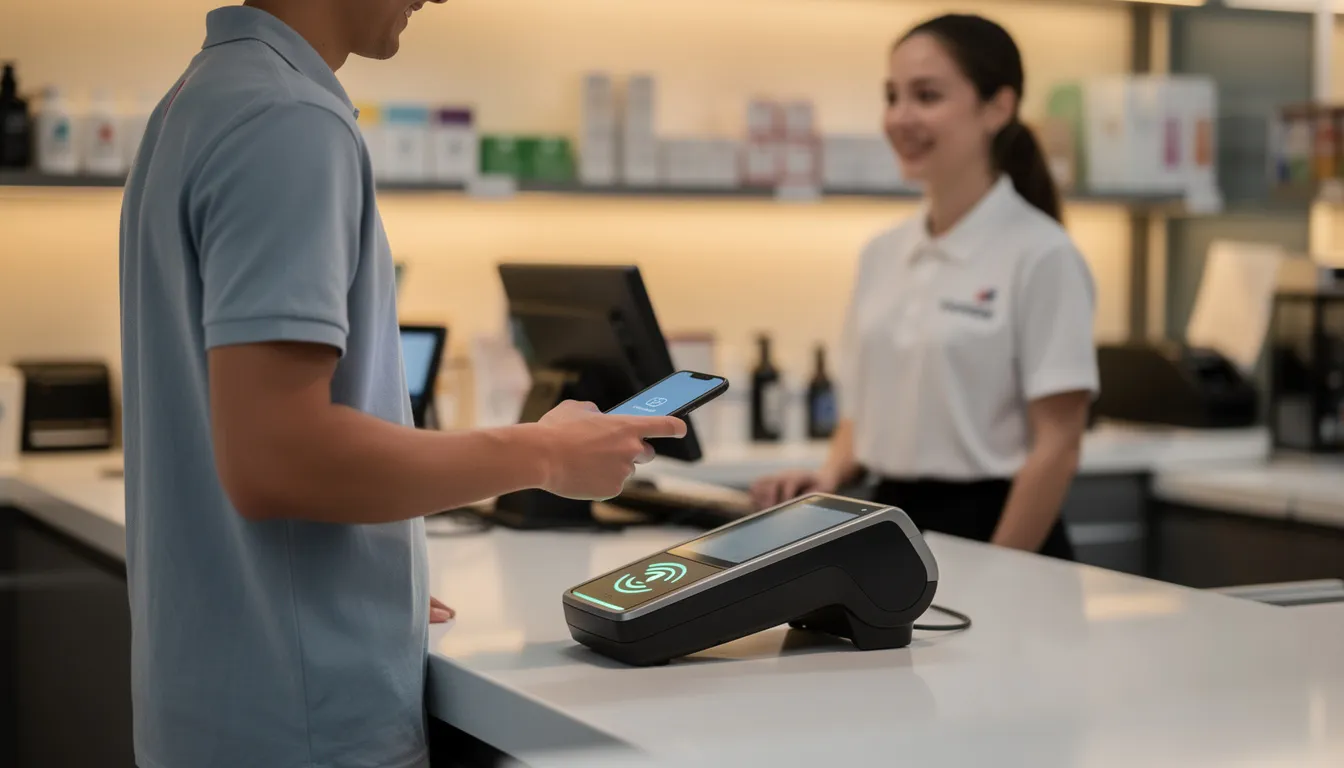
Not all card schemes work the same way. Understanding the difference between three-party and four-party models helps you appreciate why costs and acceptance vary between card brands.
Three-party (closed-loop) schemes
In a three party scheme, one company acts as both the card issuer and the acquiring bank. American Express and Diners Club are the classic examples. Because there is no separate issuer or acquirer, the scheme controls the entire relationship – cardholders deal with Amex, and so do merchants.
Merchants contract directly with the scheme rather than a third-party acquirer. This can simplify onboarding, but it also means less competitive pressure on fees. Three-party schemes typically carry higher merchant service charge rates, though their cardholders often spend more per transaction.
Four-party (open-loop) schemes
In a four-party model, the issuing bank and acquiring bank are separate entities, with the card scheme sitting in the middle coordinating data and funds. Visa, Mastercard, and UnionPay all operate this way.
This model dominates the UK market. Because multiple acquirers compete for merchant business, you can shop around for better rates. The trade-off is a more complex fee structure, with separate interchange fees flowing to the issuer and scheme fees flowing to the card network, on top of the acquirer’s markup.
Four-party schemes offer near-universal acceptance – Mastercard Visa branded cards are welcomed at over 99% of UK merchants. Three-party schemes like Amex have narrower acceptance but attract premium customers with higher average basket sizes.
We compare offers across both types of scheme and multiple acquirers to find the most cost-effective mix for your customer base.
Let us review which card brands and schemes you currently accept – and whether that mix is really optimal for your business.
Card schemes and international / cross-border payments
Card schemes make it possible for a UK business to accept cards issued anywhere in the world. But cross-border rules and fees are significantly more complex than domestic transactions.
Visa and Mastercard categorise transactions differently depending on where the card was issued and where the merchant is located:
- Domestic: Both cardholder and merchant are in the UK. Lowest fees.
- Intra-regional: Historically, this included UK and EEA. Since Brexit, UK–EEA transactions are now treated as cross-border.
- Inter-regional: Transactions between distant regions, such as a US-issued card used at a UK merchant. Highest fees.
Post-Brexit, UK businesses selling into the EU – or accepting EU-issued cards online – have seen higher scheme fees. This change, implemented around 2021–2022, has increased costs for many e-commerce merchants substantially.
Local acquirers and payment gateway providers UK can help you optimise for different markets. For instance, establishing a local acquiring relationship in the EU can reduce scheme fees on transactions with European cardholders.
International card scheme fees are typically higher for card-not-present sales, and many UK businesses overpay simply because their merchant account is not correctly optimised for regionality.
We know which acquirers and banks are most competitive for cross-border traffic. For harder-to-place industries, we also know who can offer high risk merchant account instant approval or accelerated onboarding.
If you export or sell online to international customers, let us review your cross-border fee structure and scheme categories.
What are card scheme fees and how are they different from interchange?
Card scheme fees are charges that acquirers pay directly to card networks like Visa and Mastercard for using their payment networks and services. These fees ultimately get passed through to you, the merchant.
It is crucial to understand that scheme fees are separate from interchange fees:
| Fee Type | Recipient | Typical Range |
|---|---|---|
| Interchange | Issuing bank | 0.2% (debit) to 0.3% (credit) under UK caps |
| Scheme fees | Card network (Visa/Mastercard) | Approximately 0.1% to 0.5% |
| Acquirer markup | Your acquiring bank | Variable |
Together, these three elements form the merchant service charge you see on your statement.
Scheme fees in the UK are largely unregulated and not publicly listed. Between 2019 and 2024, they have increased significantly, adding hundreds of millions of pounds in costs to UK businesses annually. The Payment Systems Regulator has scrutinised these increases, but scheme fees remain outside the interchange fee regulation caps.
Scheme fees are usually passed through to merchants in one of two ways:
- Interchange++ (or IC++): Transparent breakdown showing interchange, scheme fees, and acquirer margin separately
- Blended rate: Single percentage with no breakdown, often obscuring true costs
As your broker, we break these components down, compare card processing fees across multiple acquirers, and use our volume leverage to push down the acquirer margin. While we cannot change the underlying scheme tariffs set by Visa or Mastercard, we can significantly reduce what you pay in total.
We can translate your current statement into plain English and highlight exactly how much is going to schemes versus banks. Ask us for a free breakdown.
What do card scheme fees include?
Scheme fees are not a single charge – they are a collection of variable fees and fixed costs that schemes impose on acquirers and pass through to merchants.
Variable per-transaction fees
These fees depend on several factors, including:
- Card type: Consumer debit, consumer credit, commercial, or prepaid card transactions all attract different rates
- Transaction value: Some fees are calculated as a percentage of the sale
- Risk profile: Card-present transactions with chip and PIN are treated differently from card-not-present online transactions
- Authentication: Using 3-D Secure or other strong customer authentication can affect which fee band applies
Fixed or periodic fees
Beyond per-transaction charges, schemes also impose:
- Membership fees: Annual charges for access to the network
- Network access fees: Costs for connectivity to card payment systems
- Compliance and reporting fees: Charges for regulatory requirements and data services
As a rough guide, scheme fees typically represent a smaller fraction of each transaction than interchange, though both add up over high volumes. The exact proportions depend on your card mix, average transaction value, and sales channels.
While we cannot directly alter Visa or Mastercard’s published scheme tables, we can often reduce the total cost you pay by securing cheaper acquirer markup and the cheapest card payment machine and gateway setup for your volumes.
Start a free, no-obligation review of your effective scheme and interchange costs with us.

Key factors that affect what you pay in scheme and processing fees
Understanding what drives your costs is the first step to controlling them. Here are the main factors that affect your transaction fees.
Card type
Consumer debit cards are usually the cheapest to accept, with interchange capped at 0.2% and lower scheme fees. Consumer credit cards come next, capped at 0.3% interchange. Commercial and corporate cards sit outside these caps entirely, often carrying total costs of 2% or more. If your customers pay with business cards, your fees will be higher.
Authentication and security
Card-present transactions – where the physical card is read by chip and PIN or contactless – are considered lower risk and attract lower fees. Card-not-present transactions, such as those from your payment gateway or over the phone, face higher scheme fees due to increased fraud risk. Using 3-D Secure authentication can sometimes reduce the risk category and associated costs.
Sales channel
How you sell matters. E-commerce typically carries higher pricing bands than in-store retail. Mail order and telephone order (MOTO) transactions also sit in higher risk categories. If you operate across multiple channels, your fee structure will reflect this complexity.
Regionality
Domestic UK transactions are usually cheaper than cross-border. As mentioned earlier, UK–EEA e-commerce now falls into higher scheme fee bands post-Brexit. If you sell internationally, your effective rate will be higher than a purely domestic business.
Industry and risk profile
Some sectors face inherently higher scheme fees charged due to chargeback history and fraud rates. Travel, subscriptions, gaming, nutraceuticals, and CBD are common examples. Higher-risk businesses may also face rolling reserves, delayed settlement, and stricter onboarding requirements.
We specialise in optimising these variables where possible and matching you to acquirers who price your business fairly – even in higher-risk categories.
Let us benchmark your current effective rate against what we can obtain through our panel of providers.
How we use volume leverage to cut your card scheme and processing costs
Here is the core of what we do: because we place large aggregated volumes with UK acquirers and banks, we access pricing tiers that an individual merchant cannot usually reach alone.
Banks and acquirers give us better wholesale-style rates across their portfolios. This includes both scheme-related pass-through costs and acquirer margins. They do this because we bring them volume efficiently, reducing their customer acquisition costs.
What does this mean for you in practice? We often see total savings of 10–20% against standard bank quotes for similar volumes. Some clients save even more, particularly those who have never had their rates reviewed or who are on outdated blended pricing.
Our service to the merchant is 100% free. The bank or financial institution pays us a commission out of their margin – not by increasing your costs. This means our interests are completely aligned with yours: the more we save you, and the longer you stay with the arrangement we negotiate, the better it is for us.
We focus on long-term, transparent relationships. No hidden catches, no lock-ins that benefit us at your expense.
Upload a recent merchant statement and we will show you side-by-side pricing options from multiple providers – at no cost.
High-risk industries, card schemes and rolling reserves
Some sectors are considered high risk by card schemes and acquirers. This classification affects how merchants in these industries are treated.
Common high-risk categories include:
- Travel and ticketing
- Subscription services
- Gaming and gambling
- Nutraceuticals and supplements
- CBD products
- Certain financial solutions and services
If you operate in one of these sectors, you may face higher scheme and acquirer fees, stricter onboarding checks, caps on monthly turnover, and rolling reserves. A rolling reserve is a portion of your sales – typically 10–20% – held back by the acquirer for a period (often six months) to cover potential chargebacks and refunds.
These measures exist because card scheme rules require acquirers to manage risk on behalf of the network. High chargeback ratios – above 1% – can trigger fines, increased monitoring, or even account termination.
We already know which UK and international acquiring banks are comfortable with particular high-risk merchant codes. We know who can offer relatively fast approvals, sometimes near-instant for high risk merchant account applications with clean histories.
When we negotiate on your behalf, we aim to minimise reserve percentages, shorten reserve hold periods, and secure competitive pricing despite your higher-risk categorisation.
If you have been declined elsewhere or are in a high-risk sector, speak to our team for a discreet, no-obligation review of your options.
Choosing the right terminals, gateways and acquirers for your card schemes
Theory is useful, but let us connect it to the practical decisions you face: which terminal, which gateway, and which acquirer?
Your terminal choice – the cheapest card payment machine that still meets your needs – affects more than just hardware costs. The right setup can improve authorisation rates, reduce fraud, and even influence which scheme fee categories apply to your transactions.
Similarly, your choice of payment gateway providers UK matters for e-commerce. A well-configured gateway with strong customer authentication can reduce chargebacks and place your online transactions in more favourable pricing bands.
Buying or renting a terminal directly from a bank often locks you into a bundled package that may not be optimal. When you work with us, we compare multiple acquiring banks, payment gateways, and hardware providers to build a tailored setup for each merchant.
We pay attention to how your customers actually pay:
- In-store with chip and PIN or contactless
- Mobile payments at events or markets
- Online via e-commerce checkout
- Recurring subscriptions with stored card details
Then we align your gateway and acquirer choice to minimise scheme-related cost drivers across each channel.
Request a free proposal covering terminals, gateway, and acquiring account together – tailored to your business.
Regulation, scheme rules and compliance obligations for merchants
Card schemes enforce detailed operating rules on merchants and acquirers, layered on top of UK law and regulatory requirements such as FCA rules and PCI DSS standards.
As a merchant, you must pay attention to several key areas:
| Requirement | What It Means |
|---|---|
| Clear terms and conditions | Display your refund, cancellation, and delivery policies prominently |
| Transparent pricing | Show prices including VAT; no hidden charges at checkout |
| No prohibited surcharges | Card surcharges are banned for consumer debit and credit cards in the UK |
| Recurring payment rules | Obtain clear consent and allow easy cancellation for subscriptions |
| Strong customer authentication | Implement 3-D Secure for eligible online transactions |
| PCI DSS compliance | Secure cardholder data according to industry standards |
Merchants must not process illegal transactions, must respect issuer declines, and must follow card scheme rules for card-not-present transactions. For online merchants, schemes typically expect clear contact details, customer service information, accepted currencies, shipping policies, and legal jurisdiction to be displayed.
Non compliance with scheme rules can lead to fines, higher fees, or even loss of your merchant account – particularly for businesses in higher-risk sectors.
We help merchants understand these rules, choose compliant gateways, and work with acquirers to remedy issues before they escalate.
Ask us for a quick compliance health-check of your current card payment setup.
How we work with you: our free, no-obligation brokerage service
Working with us is straightforward. Here is how our process works:
Discovery call We start by understanding your business: what you sell, how customers pay, your current volumes, and any pain points with your existing setup.
Statement review You share a recent merchant statement with us. We analyse your current effective rate, breaking down interchange, scheme fees, and acquirer markup to identify where money is being lost.
Market comparison We approach multiple acquirers and payment gateway providers UK from our panel, requesting quotes tailored to your specific business profile.
Presentation of options We present you with clear, comparable options – showing potential savings, contract terms, and any trade-offs. You choose what works best.
Onboarding support We support you through the application and go-live process, liaising with the acquirer to ensure a smooth transition.
Our service is completely free to your business. The acquirer or bank pays us a commission from their margin – we never add to your costs.
We work with a wide panel of UK and international acquirers, covering mainstream and high-risk sectors, online and in-person sales, and businesses from small startups to multi-site enterprises.
After go-live, we stay involved. If you face issues with scheme chargebacks, fee changes, or downgrades, we help resolve them where possible.
We regularly see double-digit percentage reductions in effective rates for clients who switch through us. We work with the majority of major UK card acquiring banks, giving you genuine choice.
Take the next step
Card schemes play a fundamental role in how your business gets paid. From the card scheme sets of rules governing every transaction to the fees charged at every stage, understanding this landscape is essential – but you do not have to navigate it alone.
Whether you are a high-street retailer accepting contactless payments, an online subscription business managing recurring card transactions, or a high-risk merchant who has struggled to find acceptance, we are here to help.
We use our volume leverage to access wholesale rates. We compare offers across acquirers and card brands. We negotiate rolling reserves down for high-risk clients. And we do it all at no cost to you.